
From Widescreen to Vert
What does this say about us and our world?

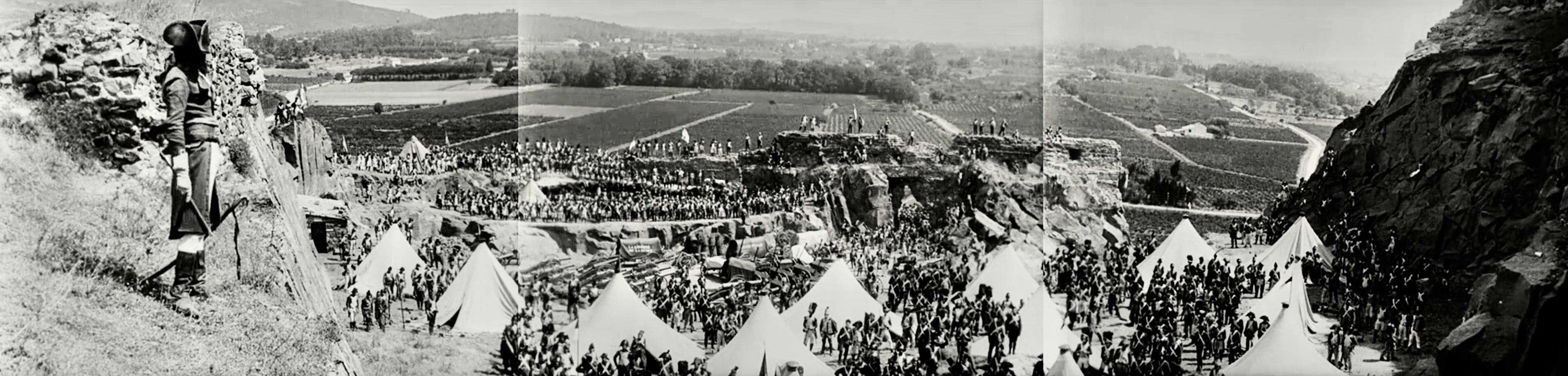
NAPOLEON (1927) Abel Gance. Cinematography Jules Kruger. Aspect ratio of 4:1 (1.33×3)
Early in Chaplin’s 1957 A King in New York, Chaplin’s character, King Shahdov, while watching a widescreen gunfight, finds himself, in order to catch each adversary, turning his head from one side to the other so rapidly and so repeatedly that he badly cricks his neck…
This is Chaplin’s satire on the new format and its lateral extravagance. Academy ratio (1.375:1, strictly speaking) had been good enough for him ever since Twenty Minutes of Love, the first film he directed in 1914. (Sadly, it lasted ten, not twenty minutes.)
With a balance of the lateral and vertical axes, this format, established by Thomas Edison in 1892, invited both a utility and familiarity that was to survive the decades, even going on to invite subsequent resuscitation after it had long been thought dead. Movie theaters and auditoria were constructed with this screen shape in view — literally. When TV arrived, its own screen adopted the same dimensions.
Academy ratio was the norm.
Room across the frame for an interior, for two, three, or more characters. Room for floor and ceiling, for land below and sky above, for hell, and if you were lucky, for heaven. Not to mention a generous stretch corner to corner for those dramatic diagonals close on 45º…
An established territory. A known universe. Despite the traumas of world wars, of cultural and technological upheaval, here was a standard ever to be relied upon. A shape for continuity no matter what…
Even as early as 1927 though, just prior to sound (not that cinema was ever silent, thanks to live music performed during screenings), Abel Gance and cinematographer Jules Kruger defied this convention in sections of their epic Napoleon with their polyvision, a triptych of academy ratio frames resulting in an aspect ratio of 4:1. (See the three joined frames in the screenshot above.)
The reach of the world was expanding, through telephony, through flight, through the shifting of peoples and here was the first attempt by filmmakers to bring its broadening compass into cinema’s canvas.
Even though this led nowhere at the time, it was to prove a premonition of what was to come.
The 1960s brought in 1.85:1 as the new standard. The increased width tempted the TV viewer away from the cosy but confined auditorium of the living room and into its brash movie theater counterpart. If America was laying claim to the century, its movie corporations were laying claim to the screen. And like their country, those outfits were not about to hold back with their hubris…
I remember as a boy being transported by the 2.76:1 Ultra Panavision sequences of 1962’s How the West Was Won. A civil war union gun carriage thundering across the screen! Not merely witnessed, this was to be experienced. The movie might as well have been titled How the Screen was Won.
2.39:1 meanwhile, was becoming yet another standard. The constraining dominion of academy ratio was inadequate to meeting a global span outstretching previous cantonized centuries now vanishing into history.
And who needed the vertical axis anyway? Because while there might be a hell — and there certainly was one often enough, on earth — who needed room for heaven? Besides, once noir’s moral uncertainty had struck, who could even believe in the great reward any more?
Range, scope, a teeming humanity, widescreen handled it all. You could get lost in its immersive lateral sweep, luxuriate in its horizontal exuberance, pity the poor, modest aspirations of its predecessor…
Not only that, the new aspect ratio gave plentiful opportunity for frames within the frame. Different aspect ratios created as the camera peered through an arch, a window, or the crack in a door. Shapes and dimensions invented and reinvented, there for the taking within the spread of the latest format…
With widescreen, the filmmaker could have their cake and eat it too.
But then, with the new millennium, something changed again. Perhaps it was that globalization rendered the blessings of the previous expansive decades unsettling. What before might have been thrillingly dizzying now began to render the world a precariously giddy place…
Gus Van Sant’s Elephant was released in 2003, just over two years after 9/11 had devastated not only lower Manhattan but ripped through the American collective psyche. The widescreen of international anger and hatred perhaps begged for containment within narrower confines. So Van Sant brought the anguish of a school mass shooting to the screen in academy ratio, even if out of which its horror only resonated the more painfully…
But the power of the format was reborn and while heaven might still be facing a tough time, Paweł Pawlikowski’s 2013 Ida, conveyed in its generous headroom within its old school academy frame, at least the sense of it…
But by now there was another force at work. Technological, cultural, habitual:
The smartphone.
Camera and screen at once. Vertical one moment, horizontal the next, depending on how it was angled. Sean Baker shot his 2015 Tangerine with an iPhone, actually three, horizontally, of course. Smartphone owners tend to give the lateral axis short shrift though. Probably because of how the thing is generally held in the hand, the vertical has become the norm, largely vanquishing its alternative.
So now we have the Vert. And what does this offer? Plentiful upright axis. Negligible horizontal scope. Space in the frame for one individual, little room for the ensemble, indeed for anyone or anything else.
Is it that the atomization of physical community concomitant with social media, or the now threatened fragmentation of communities of nations, even of nations themselves correlates with the vert’s eradication of the lateral axis and what that leaves us?
The restricted canvas of solipsism, perhaps. The reductio ad absurdum of individualism, maybe. The siloing of nationalism, of factions within it. Plenty there high up in the frame for heaven though — should anyone think to put it there. Plenty low down in the frame, on the other hand, for hell…
No longer the cosiness of the living room’s academy ratio TV. No longer the vistas of Panavision screened to the cavernous auditorium. Instead the miniature clutched in one hand. A screen, a world, its fictions shrunken like beasts stranded on an island, diminishing in stature with each successive generation…
What, we might wonder, might have been Chaplin’s take? Might he have found solace in the 1.43:1 aspect ratio of IMAX, a big screen format to counter its micro adversary? Although, come to think of it, while this may suit Nolan’s Interstellar cosmos of galaxies and black holes, it’s hardly the territory of City Lights or A King in New York.
(Mention of Nolan reminds me of those directors with a penchant for changing aspects ratios within a single film — new formal knowingness, or indecisiveness reflecting bewildering times? Perhaps this topic deserves a treatise of its own?)
But whatever the implications of the smartphone and its diminutive vert, at least we humans, up to now, can still get to decide what goes on the screen, whatever its aspect ratio.
And let’s keep it that way.…
Thank you for reading.
Peter Markham
March 2026
Originally published on Medium in Babel
Author:
The Zen of the Director: Mind and Process for the Filmmaker (Sticking Place Books) 11/25
The Art of the Filmmaker: The Practical Aesthetics of the Screen (Oxford University Press) 10/23
What’s the Story? The Director Meets Their Screenplay (Focal Press/Routledge) 9/20