
Cinema: Please Don’t “EXPLAIN” or “UNLOCK” a Film!
Can I crave what cannot be explained and avoid locksmiths?

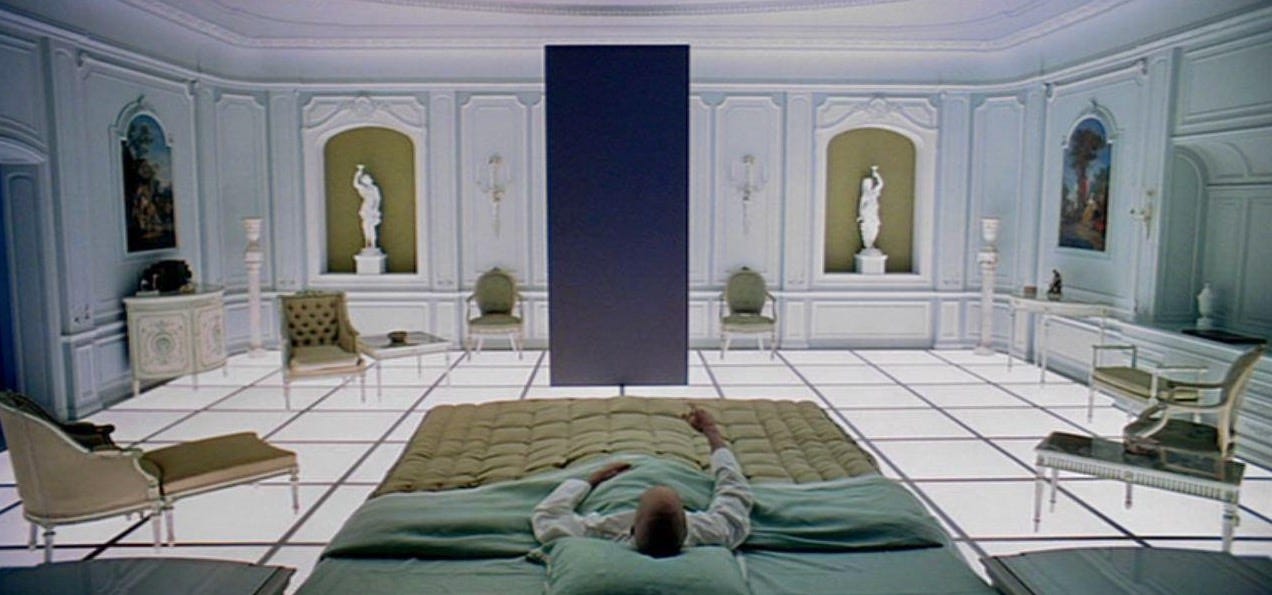
From 2001: A Space Odyssey. 1968. Kubrick. Cinematography Geoffrey Unsworth
Surely, we cannot explain poetry? We can analyze meter, rhyme, rhythm, language, figures of speech, address, ambiguities, ironies, tropes and conventions. We can categorize: the sonnet, the mock heroic, the epic, the elegy, and more. We can lay out cultural context, levels of meaning, tone, voice.
No matter the degree of deconstruction though, the essence of a poem and its resonance cannot be reduced to the functioning of a system. We cannot “explain” poetry. If we could, why bother to write it?
We cannot explain music either. Yes, we might analyze it in innumerable ways. But even if we were to deconstruct the counterpoint of J. S. Bach, we cannot explain the transcendent emotion and mystery of A Musical Offeringor The Art of Fugue nor so much as decode the simple joy of The Notebook for Anna Magdalena Bach.
But what does all of this have to do with cinema?
Orson Welles offers a clue:
A film is never really good unless the camera is in the eye of the poet.
As does David Lynch:
Cinema is a lot like music. It can be very abstract, but people have a yearning to make intellectual sense of it, to put it right into words.
How many instances have I found out there of articles and videos that purport to “explain” one film or another, Mulholland Drive, Antonioni’s L’Eclisse, to “explain” the ending of Vertigo or 2001.
What are we supposed to do with this? Are we to think now I get it, now I can put it to bed?
But why would we want to diminish the power of a film such as Vertigo or 2001, wrap it up neatly and nail it down?
Storytelling reveals meaning without committing the error of defining it.
Hannah Arendt.
Cinema is not about explanation. Make a film that explains and you might as well simply write a a paragraph or two, maybe no more than a sentence. Save yourself the effort, the trouble, the expense of getting a movie made.
Yes, we might need elements of plot explained when they aren’t clear or if for some reason we haven’t understood them but that’s about it. Plot itself can be explained, but plot is not even story, plot isn’t the sum of a film, just an instrument of its narrative, as I see it a mechanism to take the story forward. (Hitchcock’s maguffin plot of Nazi conspiracy in Rio enables the romance story of Devlin and Alicia, but the film ends with Alex walking to his doom — explain away the dissonance of that, of the unresolved emotional chasm it creates in the viewer who expects a neat ending!)
We can analyze craft, and with sufficient rigor usefully get into the mind of the filmmaker, their practice, their grasp of cinematic language — and that can enable us to develop our own practice. There needs though to be something in the vision of the filmmaker and their film which we feel, and feel deeply, yet cannot put into adequate words.
Art is not explanation. Art defies explanation. Art renders explanation beside the point.
Art is not explanation but revelation.
We can of course talk and write about film. We can look at what works and what doesn’t, in whatever way, and how that works or doesn’t. We can explore the interaction of film and viewer, how a film, through its story, storytelling, and aesthetics prompts the emotional, cognitive, and visceral journey of the audience. We can consider ambiguity and mystery without defining them…
Mysteries are not to be avoided. Rather they are a locus of hope, they enrich and complicate. That is why we have them.
Donald Barthelme.
“Enrich and complicate”! Not explain and reduce.
How do these mysteries come about? How do filmmakers, how does any artist conjure them? Not through adherence to rules, to templates, to tried and tested patterns. No, the genius of Vertigo, 2001, Mulholland Drive, L’Eclisse is born from the imagination of the filmmaker. And we can’t explain imagination or what it produces. In order to do that, to get to its workings, we would have to reverse engineer it.
Wait! Reverse engineer imagination?
Anyone who tries that has surely never experienced it nor truly appreciated its fruits.
Articles “unlocking” a scene or entire film seem to me to be related to the explaining ones. Why would a scene or a film be locked in the first place? Why would a filmmaker, writer or director or both, go to the laborious, agonizing effort of creating a movie only to lock it up so that we’d need some clever academic or commentator to come along and unlock it?
And what would it be that is revealed in the unlocking? A theme? The story? The meaning of it all? Bur wouldn’t that entail reducing a film’s resonance to a soundbite? And wouldn’t it render the self-locking writer or director indebted to the savant who’s revealed the work they for some reason best known to themselves have concealed, just as the filmmaker whose film has been in need of an explainer might be liable for gratitude.
Does cinema really need such middlemen? Great critics can enrich and deepen our sense of film but they don’t explain or unlock, they explore, connect, articulate what we might already ourselves know in part or even know but “ne’er so well express” (to get back to poetry — in this case, Alexander Pope’s).
A good critic isn’t a middleman or middlewoman but a companion, like a friend we can discuss a film with and hear their own insights. (That said, it seems to me that few critics offer too much informed discussion of craft.)
Where I might find a middle person helpful though, I have to admit, is when a filmmaker, facing censorship has chosen to be oblique. Or when I’m uninformed of the culture of a writer or director and so miss out on the full implications of their work. In such instances, okay — I benefit from enlightenment. Other filmmakers may opt to for an oblique approach for artistic reasons, what is indirect often being more powerful than what is direct. But the oblique, at its best, is not necessarily incomprehensible.
(Will the adaptation of Kazuo Ishiguru’s Klara and the Sun prove a case in point? We’ll see.)
Or could it be, when it comes down to it, that the problem is just me? Is it that I don’t have the code-breaker’s expertise and so cannot explain anything or unlock any lock but my front door’s (and even with that I sometimes need two or three attempts?
If so, I’d prefer to embrace my non-competence. Robert Bresson, one of cinema’s most illuminating visionaries, commented:
I’d rather people feel a film before understanding it.
Yes. If I can feel it, that means more to me than anything.
Pope Leo XIV, to my delight, remarked:
Cinema is much more than a screen. It is an intersection of desires, memories, and questions.
And we cannot, and surely would not wish to explain or unlock that richness…
Thank you for reading.
Peter Markham
July 2026
Originally published in ZENITE on MEDIUM
Author:
The Zen of the Director: Mind and Process for the Filmmaker (Sticking Place Books) 11/25
The Art of the Filmmaker: The Practical Aesthetics of the Screen (Oxford University Press) 10/23
What’s the Story? The Director Meets Their Screenplay (Focal Press/Routledge) 9/20