
Blue Remembered Film
A poem. A film. Many memories.

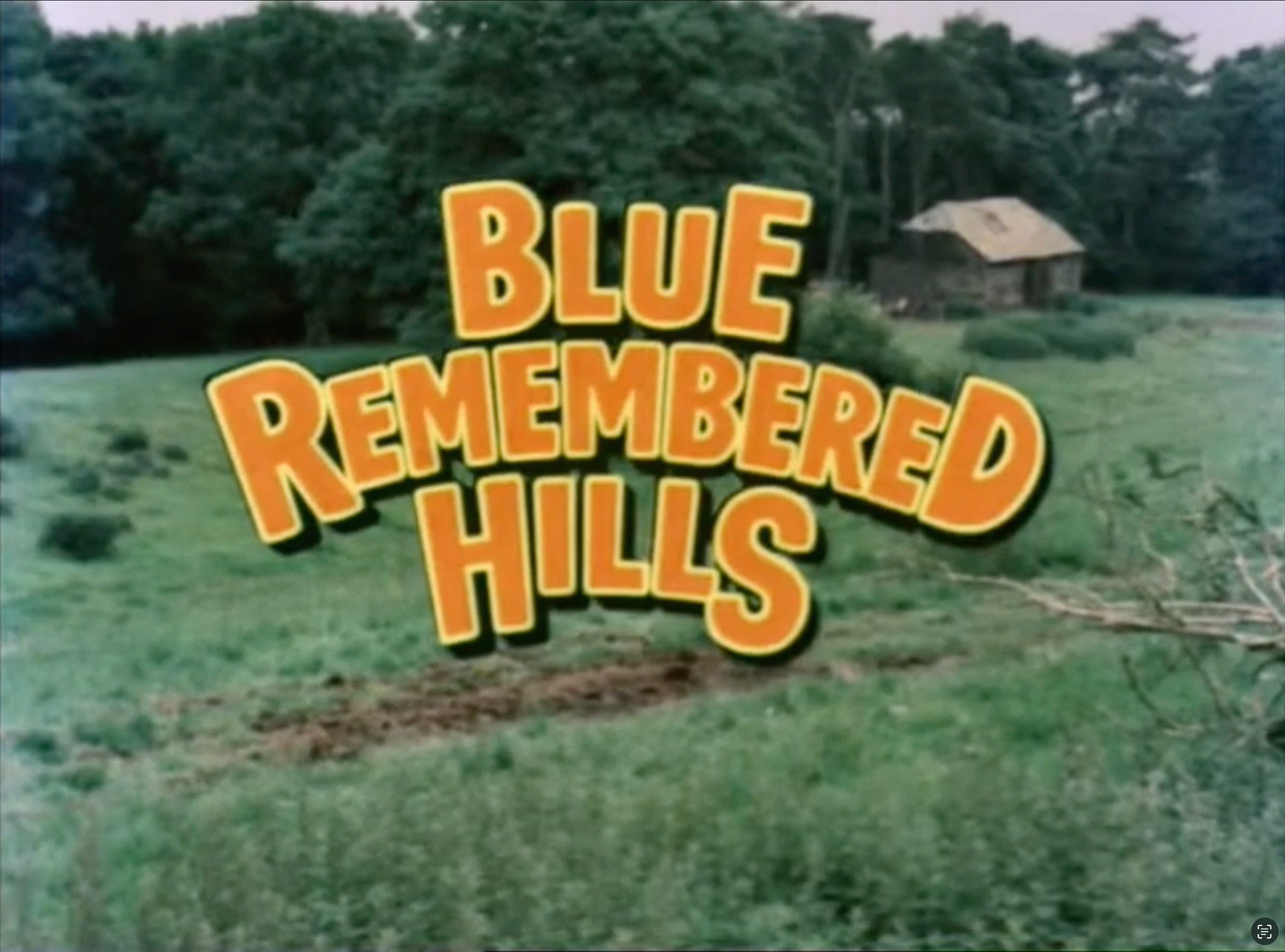
Opening of the film.
Production for Blue Remembered Hills was beginning. After the read-through (in my adopted American idiom I now say “table-read”) at the BBC Rehearsal Rooms in North Acton out on the Central Line, director Brian Gibson asked screenwriter Dennis Potter for his thoughts.
Potter offered a cursory glance around the seated cast — Helen Mirren, Colin Welland, Michael Elphick, Robin Ellis, Janine Duvitski, John Bird, Tony Robinson (for then, at least) — paused barely noticeably, then remarked, “I’m sure you can all get better.”
That disarmingly frank assessment, along with so much else, haunts my memories of working on a film so singular it might be thought to render the term sui generis inadequate.
That haunting couldn’t be any other way because haunting memory is at the heart of both the film and the poem published 82 years before its production, from which Potter took its name and was inspired to write a screenplay that drew on his childhood in the 1940s:
Into my heart an air that kills
From yon far country blows:
What are those blue remembered hills,
What spires, what farms are those?That is the land of lost content,
I see it shining plain,
The happy highways where I went
And cannot come again.A.E. Housman A Shropshire Lad 1896
Into that heart, not those lungs, comes an air. Far from the air of life however, it seems a current of death.
The air that kills, the poet writes…
Even so, it arrives with a vision, a landscape, the terrain of rural England, luminous in the poet’s present tense. What are those sights, those places he witnesses? Can their natures be revealed? Can the mystery of this vista — so vivid the poet sees it shining plain — can its meaning, be found, be explained?
The happy highways… he begins, with a fleeting note of reassurance before wrenching their radiance from us with his abrupt schism of tense…
The happy highways where I went
They are but now they were… Housman snatching his remembered spectral vision away from us even before we can savor its mesmerism.
The happy highways where I went
And cannot come again.
Those highways, that happiness, gone forever. Just as those hills have been leveled by the poet’s word plain so his epiphany has been replaced by the realization of loss, his canvas, like what we assume to have been his childhood, all too ephemeral.
In search of lost time, Housman had found it — only for it to slip away somewhere between two lines of his stanza.
A. E. Housman, born in Worcestershire, admitted he’d hardly spent any of his life in Shropshire, not as a “lad”, nor as a man. So where are/were theseblue remembered hills? In which county? In any? Did they exist somewhere in England during Housman’s English childhood and still exist, or did/do they exist only in his mind?
And so those haunting lines haunted Dennis Potter, evoking memories of his own early days in Gloucestershire’s Forest of Dean, tucked away to the south of Shropshire in the west of England before England gives way to Wales. Another county facing another country.
I’ve spent a little time in the Forest of Dean and found its pervasive shadow sombre to say the least — a darkness the remnant of the area’s past coal mines perhaps, the pits the local men labored in, their daily katabasis a descent from morning to night without the hours of daylight between. Like the growing figurative darkness Potter evokes in his own Blue Remembered Hills.
Potter’s screenplay tells the story of six forest children at play among the fields and trees in the last years of the Second World War, one of them, a bullied outcast, seeking safety but finding only danger in the enveloping gloom of a wooden barn.
But there’s more. The children in the film were not to be played by children but by adults. Such a verfremdungseffekt proved irresistible to actors and, one by one, from Helen Mirren on, director Brian Gibson assembled his remarkable cast.
We shot the film in Wiltshire, another county, on the borders of Dorset and Somerset, two more. The estate at Stourhead was close by, where Kubrick had shot scenes for Barry Lyndon, another film in which shadow — in the master’s movie faintly illuminated by candlelight — seems to prompt fate.
But before the shoot and after the read-through came the rehearsals in London — Greater London — my county of origin.
I was “on the book”. Supervising the action props. Calling the actors. Spending time with director Brian Gibson at the end of each day. Gibson was brilliant. The cast knew it. We all knew it. You can see it in the film. He possessed a cinematic vision evident in his mise-en-scène, his camera, its placement and movement. The son of a carpenter from Southend-on-Sea in Essex, another county, he had already distinguished himself while a Cantabrigian undergrad.
His intellect, his breadth of knowledge were comprehensive. So was his ambition, later to bring him to Hollywood. He was demanding, of himself and of us all. Once, he expected me to drop everything in the middle of rehearsals and hurry down to the Forest of Dean to record the dialect of locals in pubs. When I demurred, unable to find a Nagra to record with, still less being remotely capable of operating it, and trying my best to cope with my own job without mutating overnight into a neophyte researcher, he was furious, at one point hurling chairs at the wall of the rehearsal room. “It’s the director who looks a c…! when the film goes wrong,” he yelled, loud enough to be heard miles from North Acton and back in our production office at the Television Centre in White City.
But he was a filmmaker to his bones and unlike some, he was fun too . (Although perhaps not at that moment.)
And if you know anything of the English class system and you’re not from the few privately educated per cent who pervade the Brit establishment, you know about a rage like his. You might even feel something of it.
Gibson could be ruthless too. Tony Robinson, later popular compere of Brit TV history shows, was to play Donald, the outcast. A few days into rehearsal, Gibson felt it wasn’t working out. He pondered, then fired the actor on the spot. Robinson was hugely disappointed. I found myself in the position of listener to his grief, yet discovering in the throes of his frustration a poise in the man I’m not sure I’d ever be capable of mustering. Philosophical, dignified, Robinson left North Acton and what was to be become a milestone in Brit TV, to make is own mark later on…
The travel day came.
West London to The Old Ship, a hotel in the town of Mere, Wiltshire, where the unit was to stay.
At the time I was attempting to learn to drive. Quite a challenge for someone of my dubious coordinative abilities. Janine Duvitski, playing the goofy Audrey, had a Mini and suggested I drive us the 100 miles. So we put up learner plates and off we went.
The traffic was terrible and it took an age but we made it, creeping past Stonehenge on the way. Plenty of lost time in those venerable sarsens, although nothing of it — blue or otherwise — remembered through the millennia.
And finally, I was starting to get something of a sense of how to drive — all I’ve ever had.
The rest of the cast arrived. Colin Welland, playing Willie, his screenplay for Chariots of Fire later to win an Oscar — see his The Brits are Coming speech — walked into the bar announcing in his stentorian Yorkshire tones this is the soft oonderbelly of England, a sentiment that I, as a soft southerner all too familiar with the existential pain common to us all, north and south, east and west, signally failed to appreciate. I mean, hadn’t he read Potter’s screenplay?
But that was Welland. I’d grown up watching him playing a copper in TV’s Z Cars and as with Mirren, I was star struck.
No sooner had Michael Elphick, later star of TV’s Boon and playing Peter, arrived than he began to down his daily bottle of vodka, a libation that appeared to have little effect on his lovely kindness but was to have every impact on his future health, or lack of it.
Robin Ellis, destined for Merchant-Ivory’s The Europeans was there to play John, while satirist John Bird, playing Raymond, joined us next.
Everyone, including Helen Mirren, playing Angela, was at The Old Ship, everyone that is, apart from any actor playing Donald, the role that still needed recasting. No matter. Poor Donald’s scenes were scheduled for later in the shoot.
DP the genial Nat Crosby was present. Production designer the professorial Richard Henry too. Kenith Trodd, enfant terrible of BBC Drama and the film’s producer turned up in his familiar grumbling glory. Also there, the somewhat dissolute first assistant director, my friend and immediate boss Jerry Desmonde, son of vaudevillian and mainstay of English comedy Jerry Desmonde Sr, who in defiance of the laughter he’d evoked, had taken his life ten years before, the scars of which event were etched into his son’s jovial features.
Shooting began the next day…
There was a single location. A green field sloping gently down to a dark wooden barn doomed to demolition anyway but as an element of the story destined instead for conflagration. I recall the date over its double doors: 1843.
53 years before the publication of Housman’s poem.
135 years before our filming.
A century before the action in Potter’s story.
183 years before I write this.
A couple of hundred yards to the left of the barn lay the woodland in which much of the action was to be staged. Far off to right, in the distance, lay the blue hills — except that they did not. I always recall this incorrectly. There were no distant hills, no farms, no spires. Only in my mind were they there, there to watch over us…
The actors donned the clothes of the 1940s children, shorts and pullovers for the boys, a cowboy hat for Raymond, a dress for Angela, skirt and top for Audrey. The camera gear was unloaded, the sound equipment too, the action props — a toy pram (baby carriage) and a doll—kept at hand, and so began the days of the shoot in and around the woods, up and down the field…
The rivalry of the boys, their scuffles, their jokes and puns, their fragile alliances and jealousies played out alongside the mischief of the girls: Audrey’s naughty pledges, Angela’s mimicking of an adult world she barely understood. Their gossip. Their games. But above all, the group’s terror, prompted when the wail of a siren announced the escape of an Italian POW from a nearby prison camp. The group were petrified. Would he ambush them? Would he hurt them, Might he even kill them? All they could do was hunker in a hollow until the POW, who was of course never anywhere to be seen, could be forgotten.
Then there was the boy who was never there. No one could ever live up to Wallace Wilson. Wallace would never deign to be in their gang, aspire as they might to be in his privileged company. And who would have played Wallace anyway? Better that he remained off camera and on the screen of our minds.
The motto of my grammar school in Hampshire, another county, in another forest, The New Forest, was Inter Silvas Quaerere Verum: to seek the truth among the trees. It wasn’t among those trees that the gang was to find their truth though, it was out of them, down by the barn.
The barn was the territory of Donald, antithesis of paragon Wallace, outcast, runt, everyone’s whipping boy, Donald, whom others would make cry to spare themselves their own tears.
The drama of the shoot itself, thankfully tended to be less raw than the fiction. Gibson knew what he was doing. Everyone believed in the project. We knew it was special. We simply got down to work.
The most intense episode for me, I remember, came with Jerry Desmonde’s idea of a joke, which it turned out was not mine.
Gibson had employed what we call a cherry picker, a truck with a high crane on its bed for a shot that started high up in the trees and boomed down through the branches to the children on the forest floor. Desmonde convinced me to go up in its cradle after a day’s shoot so that I might survey the surrounding landscape. I thought perhaps I might even make out those hills, blue and remembered. Unfortunately for me, I forgot about my pathological fear of heights.
Desmonde operated the controls, lifted me to the heavens but then proceeded to swing me around in vertiginous loops. I screamed to be brought down but the more I yelled the more Jerry laughed, and with his hilarity came speedier, more dizzying circles. I saw no hills, blue, remembered or otherwise, only the last moments of my being, which, fortunately, remained purely the images imprinted on my desperate foreboding.
Jeanine Duvitski’s Mini, meanwhile, continued to be my driving classroom. In the evenings the cast liked to go to a pub in a nearby village. None of the actors wanted to drive so, learner plates up, I was chosen as the designated driver. (One of the cast undertook to stay under the limit and keep the arrangement legal but still didn’t care to drive. I, of course, had to eschew the pint or two of the local bitter that I craved.)
I still can’t work out how Mirren, Welland, Ellis, Duvitski, Bird, and Elphick, plus myself, all managed to fit into one Mini. Minis today, are practically the size of Hummers, but not then. Well, somehow we defied the laws of classical physics, everyone got in, and we would make it to the pub.
But the responsibility of it! There I was with not only the steering wheel but the lives of the stars in my hands. What if anything had happened en route? Think of the movies that would never have got made — all down to me and my suspect driving abilities.
Then, a week or so into the shoot, Donald was cast, Colin Jeavons chosen for the role. Perfect! Again, Gibson’s intuition at work. As with his character, Jeavons kept away from the others, never part of their social life, never with us in the Mini (not that there was room) just as his Donald never joined the antics in the woods. It was Colin’s hotel room that was his domain, the barn Donald’s.
And it is to the barn that, at the end of the film, the children run. Their plan? Willie will mimic the Italian POW escapee, threatening Donald from outside the barn doors. The fear they themselves felt before they will now inflict on the outcast.
Meanwhile, inside the barn, Donald has been playing with lit matches…
And so Potter’s story and Gibson’s film’s production, reach their climax. As with the sacrifice fundamental to any tragedy worth its salt, and to this Forest of Dean drama, the venerable barn is immolated. Watched by the characters in the film, and the crew making it, the structure succumbs to the enshrouding flames, its timbers and beams, sturdy since 1843, collapsing into a charred heap soon to be cleared away leaving the meadow empty again.
Only the final scene is left…
Dotted in a field of ripening wheat, Angela, Audrey, Willie, Peter, John, and Raymond decide to get their story straight. None of them, they will insist, were anywhere near when the inferno happened…
And with the salving of their conscience for what occurred to Donald comes the wrap on the shoot.
Next day cast and crew pack up and leave Mere. I drive Janine back to London in her trusty Mini and a couple of months later, at my third attempt, pass my driving test.
Thank you for reading.
Peter Markham
June 2026